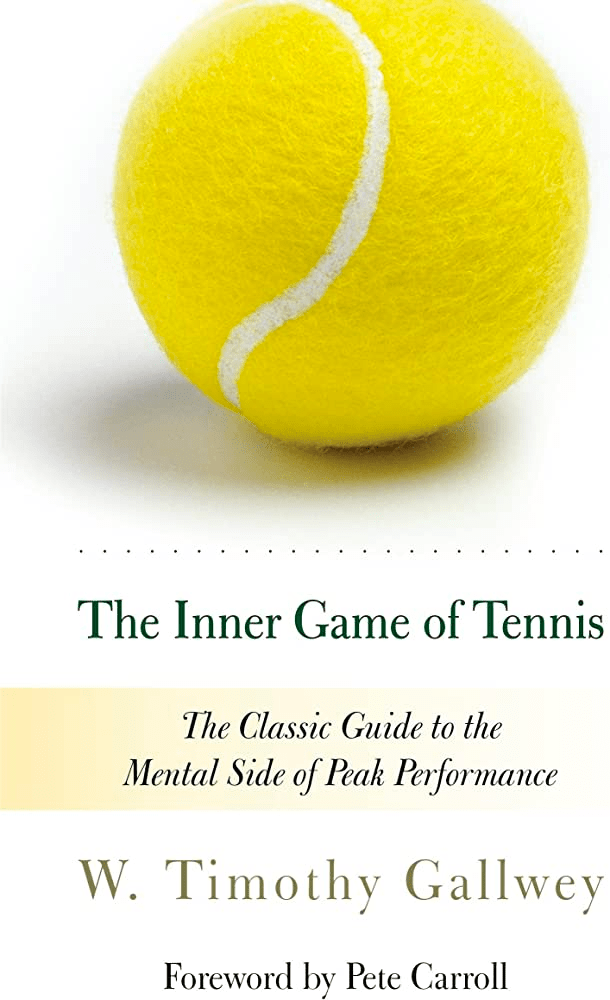
I finished reading The Inner Game of Tennis by W. Timothy Gallwey this morning, which is one of those books where if you get into the arena of mental models, performance, and general satisfaction, tends to get referenced quite a bit. So after it sat on my shelf for a year or two, I finally read it.
I think there are two basic strands from this book that might be important. First is the mental model Gallwey introduces, self 1 (the assessor, judger, ego, etc.) and self 2 (who you are when you let go of all of that). It’s a model as good as any other, whether that’s below the line / above the line from the Conscious Leadership Group or getting more scientific and talking about the frontal lobe and the limbic system (see The Chimp Paradox, etc.).
More interestingly, I think, Gallwey talks about how we learn, using tennis as a model. His thesis boils down to: we should spend way less time telling people what to do, and instead show them examples of how to do something, let them try it, and ask coaching questions to keep improving. If we do this, we get away from self 1, and let self 2 do the learning and performance that it’s so good at (he compares this to “being in the zone”).
What if a player has never learned to play in the first place? Don’t they need some basis for instruction? “The answer is: if your body knows how to hit a forehand, then just let it happen; if it doesn’t, then let it learn.” (39)
On instruction: “a valid instruction derived from experience can help me if it guides me to my own experiential discovery of any given stroke possibility.” (54) More: “So I believe the best use of technical knowledge is to communicate a hint toward a desired destination. The hint can be delivered verbally or demonstrated in action, but it is best seen as an approximation of a desirable goal to be discovered by paying attention to each stroke, and feeling one’s way toward what works for that individual.” (56)
Finally, a word on winning that I found poignant: “Winning is overcoming obstacles to reach a goal, but the value in winning is only as great as the value of the goal reached.” (120)
After finishing the book, I find myself thinking less about the mental model and more about instruction. When I coach and teach people, am I giving technical instruction or am I showing them and letting them learn?
 The Minimum Blues
Leave a comment